pureLiFi Held A Webinar To Discuss Their Bridge XC Flex
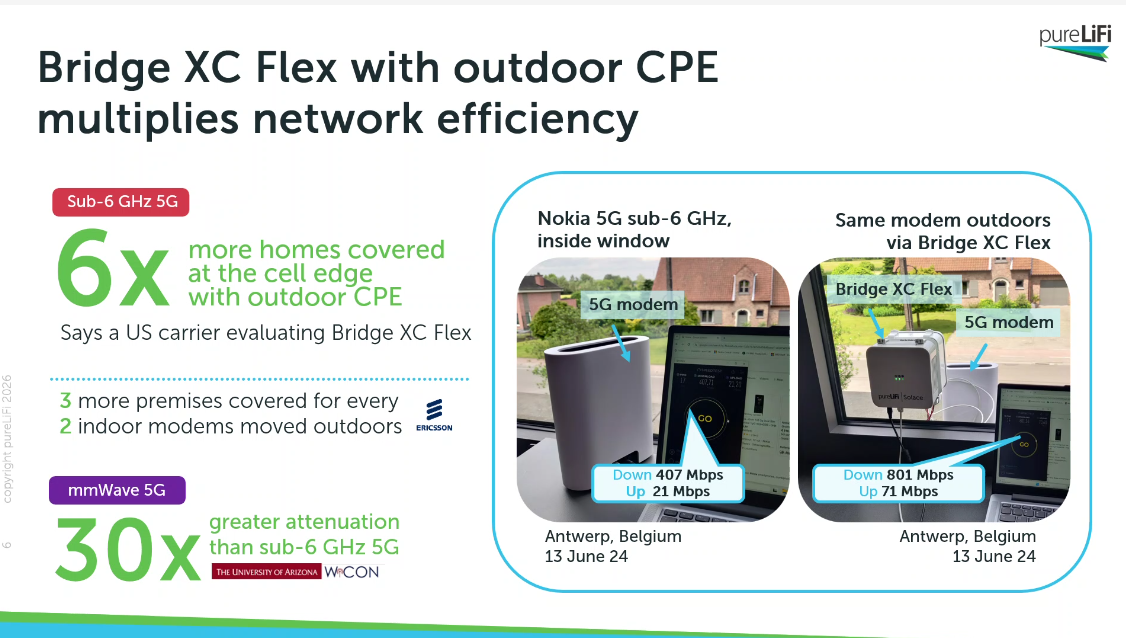
Image credit to pureLiFi
Today, pureLiFi held a webinar. pureLiFi’s Commercial lead, Bart Bowser, and Co-Founder and Chief Product & Technical Officer, Mustafa Afghani, introduced the Bridge XC Flex, an innovative, user-installable optical bridge designed to bring high-speed outdoor 5G, satellite, and fibre connections indoors without a single drilled hole.
The 5G FWA Bottleneck: A Wall of Attenuation
Carriers and Internet Service Providers (ISPs) have increasingly turned to Fixed Wireless Access to deliver broadband to consumer and enterprise customers. However, they face an age-old challenge: getting the signal indoors.
Modern building fabrics heavily attenuate 5G signals. The challenge becomes even more severe with high-speed millimeter-wave (mmWave) 5G, which suffers up to 30 times more attenuation than sub-6 GHz spectrums when attempting to penetrate walls and energy-efficient windows.
To bypass this, carriers have started deploying outdoor modems (CPEs) to capture the unhindered 5G signal outside the home. By moving the modem outdoors, carriers require less power to reach the device, increase overall network capacity, and significantly extend their coverage area from the base station.
Yet, this introduces a new logistical nightmare: getting the data from the outdoor modem to the indoor router. Historically, this has required professional installers, drilling holes through walls, and routing physical cables. For renters, residents of listed buildings, or commercial tenants in glass-fronted properties, this is often impossible due to a lack of landlord permissions or structural limitations. Even when permitted, professional installations add massive costs for the carrier and result in long waiting lists for consumers.
Enter the Bridge XC Flex
The newly unveiled Bridge XC Flex elegantly solves this problem by using the window glass itself as the data bearer. The product consists of a two-part system: an indoor bridge unit and an outdoor bridge unit. They are affixed to opposite sides of a window pane using a non-chemical, trace-free adhesive that allows for easy repositioning without damaging the glass.
Using invisible infrared light, the Bridge XC Flex establishes a bidirectional optical wireless link straight through the window. Because the technology relies on light rather than radio frequencies (RF), it penetrates the glass without any of the attenuation challenges that plague 5G and Wi-Fi signals.
What truly sets the Bridge XC Flex apart, however, is its power delivery system.
"What really enables this solution and makes this user-installable is the fact that the outdoor bridge unit requires no fixed infrastructure at all," explained Mustafa Afghani. The indoor unit wirelessly transmits power through the window to the outdoor unit. In turn, the outdoor bridge can provide up to 20 watts of Power over Ethernet (PoE) to any attached outdoor CPE.
This means a user can simply stick the outdoor modem and the Bridge XC Flex to the outside of their window, connect them with a short Ethernet cable, and the entire outdoor array is powered and connected purely from the indoor unit. Installation time is slashed from weeks of waiting for a professional to a self-guided process that takes under 30 minutes, with the bridge units themselves taking less than 10 minutes to mount.
Real-World Impact and Unmatched Flexibility
During the webinar, pureLiFi shared compelling data from early customer trials. One major US carrier reported that by enabling customers to easily move their CPEs outside using the Bridge XC Flex, they could cover six times as many homes at the cell edge with their existing infrastructure.
In a real-world trial in rural Scotland, a property situated outside the official EE 5G coverage map experienced transformative results. An outdoor modem was paired with the Bridge XC Flex, with the outdoor bridge notably installed by a five-year-old child to demonstrate its simplicity. Bypassing the indoor signal block allowed the modem to connect to a distant 5G tower, resulting in a 3-fold increase in download speeds and a 10-fold increase in upload speeds. Similarly, an experiment in Belgium saw download speeds jump from 400 Mbps indoors to 800 Mbps outdoors, while uploads tripled.
The "Flex" in the product's name denotes its agnostic nature. Because the units are simply Ethernet-enabled, they are not limited to 5G FWA. Use cases presented during the webinar included:
Satellite Connectivity: Relaying connections from Starlink terminals into homes or mobile command centers without drilling through walls or vehicle chassis.
Fiber Deployments: Passing signal from an outdoor Fiber ONT to an indoor network in properties where drilling is prohibited.
Outdoor Wi-Fi Extension: Reversing the flow to take an indoor network connection outside, seamlessly extending Wi-Fi coverage to gardens or outdoor spaces.
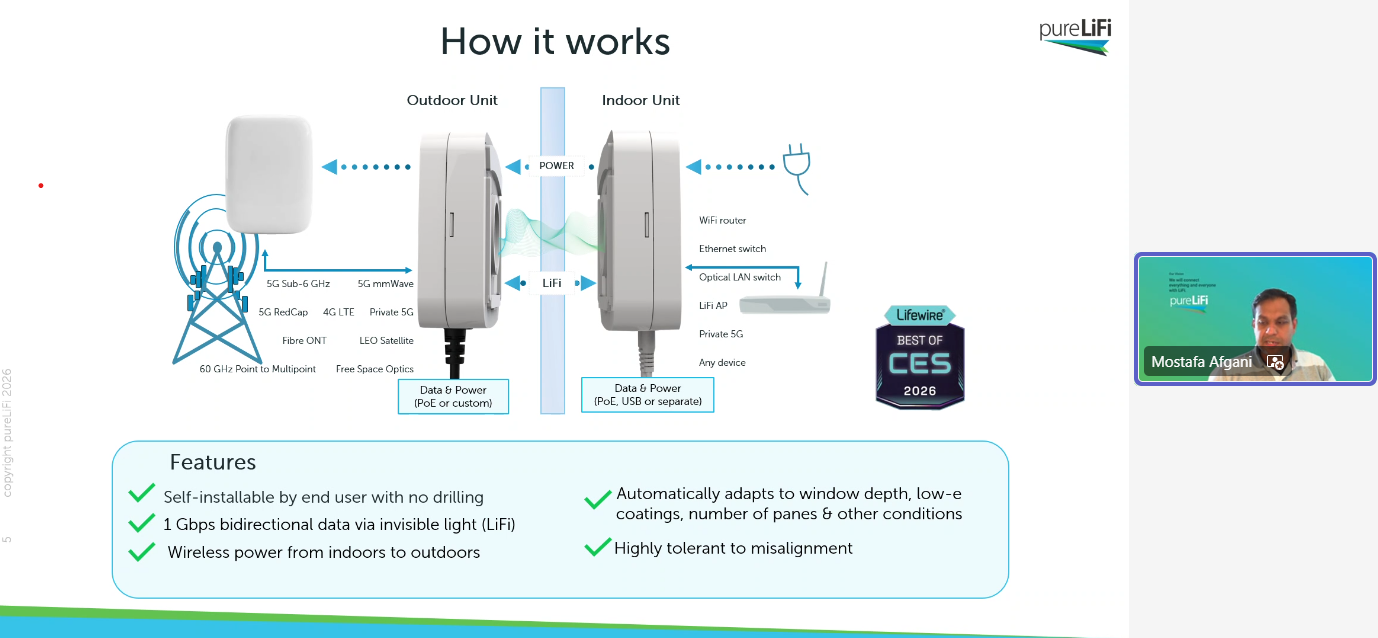
Image credit to pureLiFi
LiFi vs. RF Bridges
While some competitors are attempting to build window-bridges using 6GHz Wi-Fi or RF technologies, pureLiFi argues that optical links are inherently superior. Energy-efficient window coatings can block up to 99.9% of RF signals, forcing Wi-Fi bridges to consume vastly more power to maintain a link.
Furthermore, RF signals leak and spread. A Wi-Fi bridge can cause interference with the user's own indoor 6GHz home network, eating up valuable capacity. Conversely, the Bridge XC Flex’s infrared link is tightly contained between the two aligned units. It creates zero interference, is completely immune to external RF noise, and offers physical-layer security since the beam cannot be intercepted from outside the direct data path.
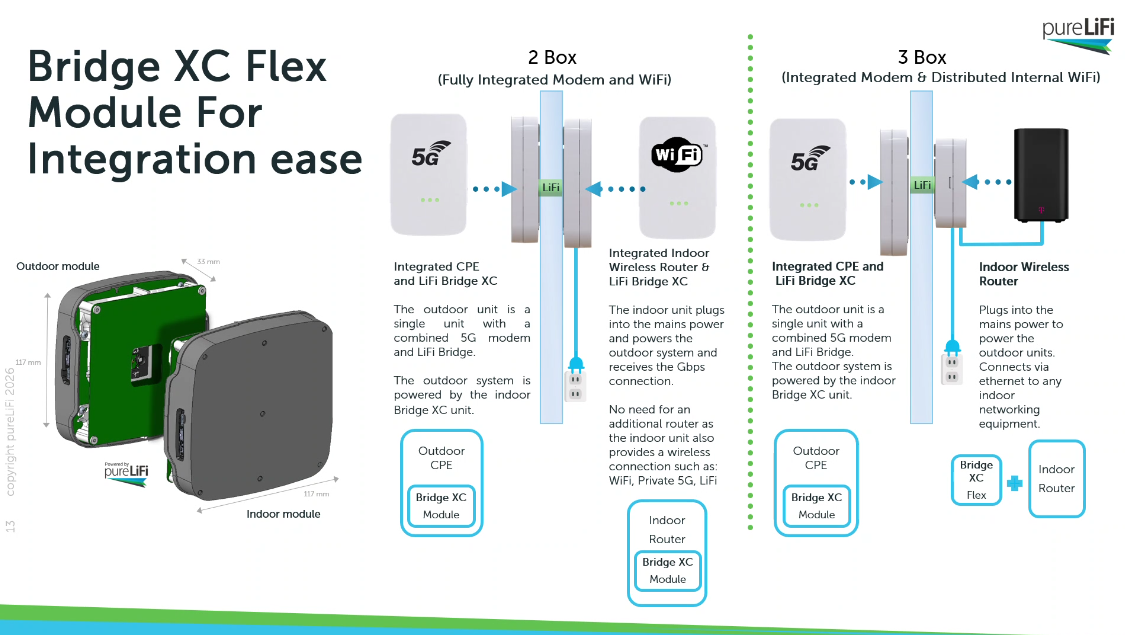
Image credit to pureLiFi
The Road Ahead
Launching commercially in Q4 of this year, the Bridge XC Flex currently delivers a guaranteed, symmetrical 1 Gigabit link regardless of window thickness or low-E coatings. The outdoor unit features an IP65 rating, ensuring resistance to harsh weather and window cleaners alike.
pureLiFi is also making the Bridge XC Flex internals available as a module for OEMs and CPE vendors. This will allow hardware manufacturers to build "two-box" solutions, integrating the 5G modem and the outdoor bridge into a single, sleek outdoor unit, paired with an integrated indoor bridge and Wi-Fi router.
For those worried about future-proofing as 5G networks get faster, Afghani offered a glimpse into pureLiFi's roadmap. Following demonstrations of a 5 Gbps link at MWC 2025, the company's advanced technology team successfully tested a 10 Gbps link earlier this year.
By eliminating the need for drilling, drastically cutting installation costs, and unlocking the true speed of outdoor networks for indoor users, pureLiFi’s Bridge XC Flex isn't just an accessory, it is the vital catalyst the telecom industry needs to finally unlock the mass adoption of Fixed Wireless Access.