QuINSiDa Successfully Integrates LiFi and Quantum Security in Groundbreaking Wireless Setup
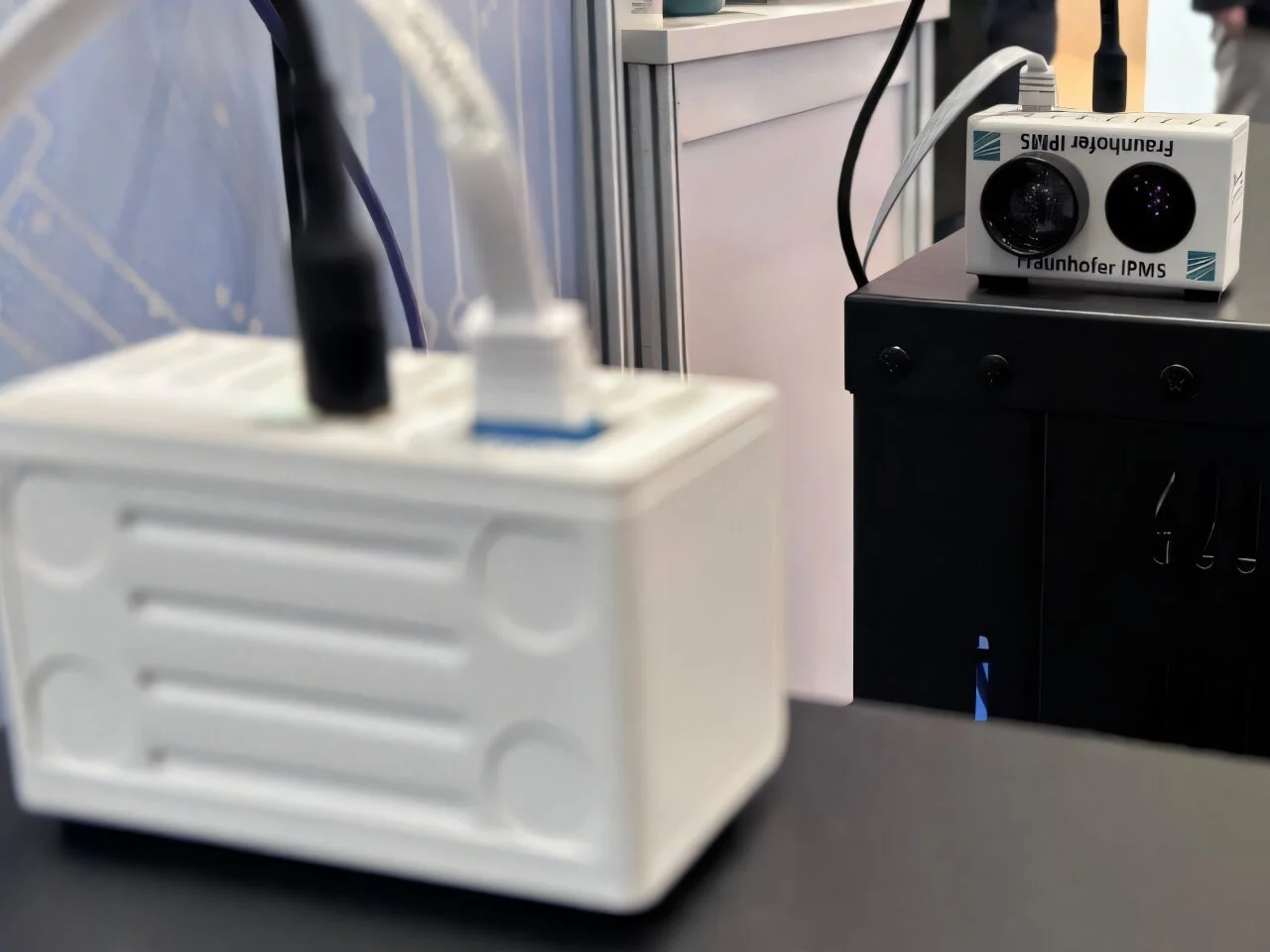
Image credit to Fraunhofer-Institut für Photonische Mikrosysteme IPMS
By LiFi Tech News Team
For years, the gold standard of secure communication, Quantum Key Distribution (QKD), has been physically tethered to the ground, heavily reliant on dedicated fibre-optic networks. While incredibly secure, this dependency severely limits flexibility. But what if quantum-secure networks could go mobile?
In a major leap forward for both the optical wireless and quantum communication sectors, QuINSiDa has demonstrated a first-of-its-kind free-space data transfer channel that seamlessly integrates LiFi with major QKD implementations.
Complete with key management (KMS), encryption, and real-time monitoring, this integrated optical-wireless quantum security stack proves that quantum-level security is finally ready for the wireless world.
The Breakthrough: Cutting the Cord on Quantum Security
Historically, securing data with quantum encryption meant laying down expensive, inflexible fibre cables. QuINSiDa’s new architecture entirely bypasses the need for fibre or traditional radio frequency (RF) channels. Instead, it uses a line-of-sight optical link to deliver quantum-secure keys.
In their laboratory demonstration, the consortium successfully combined free-space Continuous-Variable and Discrete-Variable QKD (CV/DV-QKD) with LiFi technology. By connecting this to network management and telemetry workflows, they have created an end-to-end system that isn't just a proof-of-concept, but a highly deployable, maintainable solution ready for real-world critical infrastructure.
Technical Highlights: How It All Works Together
Integrating highly sensitive quantum channels with high-speed LiFi data transfer is no small feat. The genius of the QuINSiDa setup lies in wavelength separation, allowing multiple optical channels to operate simultaneously within the same wireless environment without interference:
Continuous-Variable QKD operating at 1550 nm
Discrete-Variable QKD operating at 810 nm
LiFi data transmission operating in the 850–940 nm range
Rather than relying on a separate, dedicated channel for classical communication, the QKD post-processing data is transmitted directly over the LiFi link. This simplifies the architecture immensely.
To maintain the ultra-precise alignment required for free-space optical links, the system uses a Pointing/Acquisition/Tracking (PAT) subsystem. LiFi plays a crucial role here: it handles endpoint identification and localisation, providing the critical feedback channel the PAT system needs to keep the quantum link perfectly aligned.
The Role of Fraunhofer IPMS
A key driver behind the LiFi integration in the QuINSiDa project is the Fraunhofer Institute for Photonic Microsystems (IPMS). Building on more than 15 years of pioneering experience in optical wireless systems, Fraunhofer IPMS developed and integrated the LiFi-based optical wireless communication components.
They provided the highly specialised optical transmitter and receiver systems required to make wireless, quantum-secure data transmission a reality. Furthermore, Fraunhofer IPMS is actively developing a telescope-based optical free-space communication system to fully replace the remaining fibre-optic links between QKD components, setting the stage for a 100% wireless QKD-over-LiFi ecosystem.
What This Means for the Industries
This convergence of light-based data transfer and quantum cryptography is a watershed moment. Here is what it means for both sectors:
For the LiFi Industry
This achievement fundamentally elevates LiFi from being viewed as just a high-speed, RF-free alternative to Wi-Fi, positioning it as a foundational pillar of next-generation, ultra-secure networks. By proving that LiFi can serve as the robust classical communication and feedback backbone for quantum encryption, the technology gains massive credibility in the defence, maritime, and critical infrastructure sectors. It opens up highly lucrative, specialised markets where absolute data sovereignty is required, proving that LiFi is indispensable for the future of secure communications.
For the Quantum Industry
For the quantum sector, this solves the infamous "last mile" problem. QKD has traditionally been bottlenecked by its reliance on fixed, expensive fibre infrastructure. QuINSiDa’s breakthrough frees QKD from the ground, unlocking mobile and temporary quantum security deployments. This means quantum-secure encryption can now be deployed in dynamic environments, such as ship-to-shore maritime connectivity, aviation, moving automotive networks, industrial campuses, and temporary disaster-relief networks. It shifts quantum security from theoretical, fixed-point infrastructure into practical, real-world operational readiness.
Looking Ahead
With this achievement, Germany has taken a massive step toward the future of mobile security applications. By bringing quantum-secure encryption into real-world operations via optical wireless links, the QuINSiDa project has proven that the future of ultimate data security isn't just quantum, it's wireless, and it's powered by light.