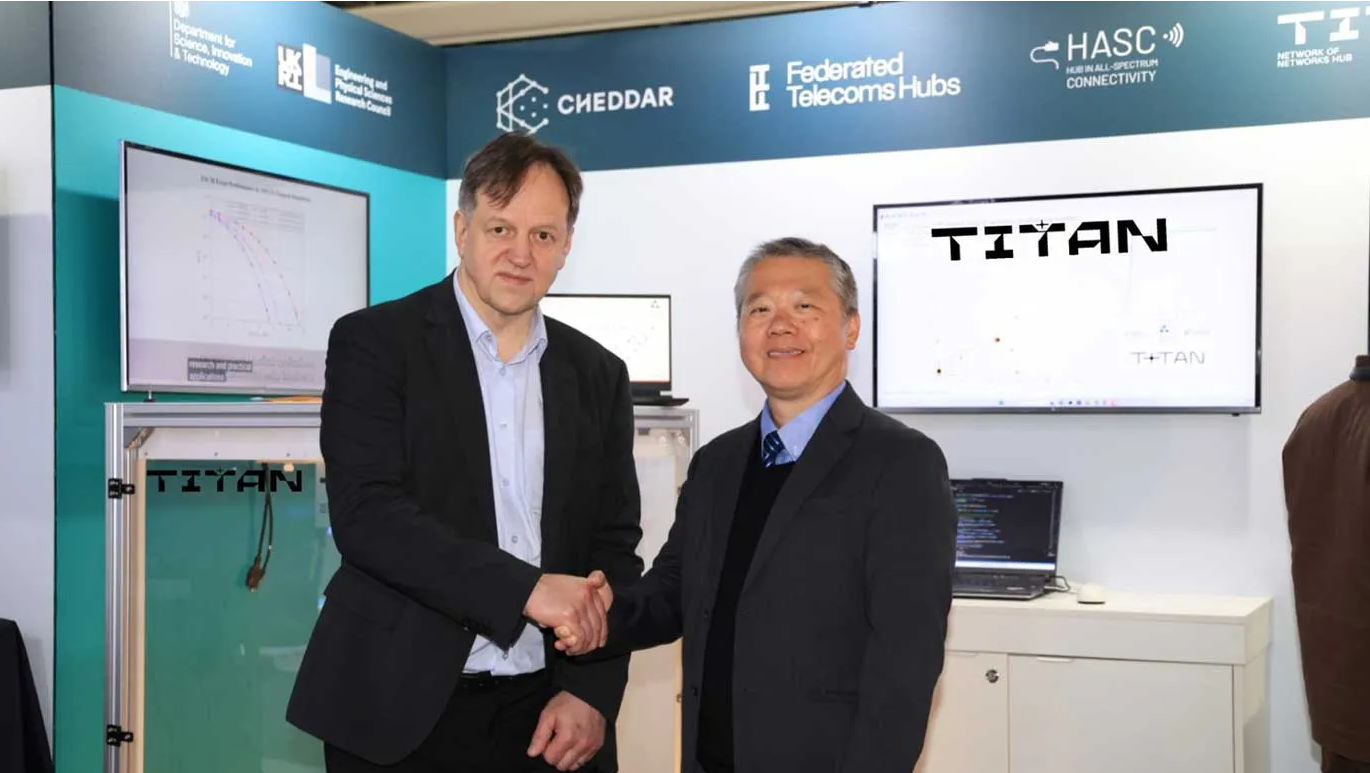
Image credit to University of Cambridge
By LiFi Tech News Team
This week, a landmark partnership was announced that sets the stage for this new era: the UK’s TITAN (The National Hub on Network of Networks) and Taiwan’s Industrial Technology Research Institute (ITRI) have signed a Memorandum of Intent to redefine the future of terrestrial and non-terrestrial networks (NTNs).
Led by the University of Cambridge and supported by the Federated Telecoms Research Hubs (FTH), this collaboration aims to merge high-performance radio frequency (RF) technology with the untapped potential of Optical Wireless Communications (OWC), better known as LiFi.
A Vision Beyond the Tower: Terrestrial Meets Space
For decades, mobile connectivity has relied on ground-based towers. However, 6G aims to provide "ubiquitous connectivity", internet that follows you into the deepest valleys, across the oceans, and into the most remote industrial sites.
To achieve this, the industry is moving toward a "Network of Networks" (NoN) model. This integrates:
Terrestrial Networks: Traditional 5G and 6G cell sites.
Non-Terrestrial Networks (NTNs): Low Earth Orbit (LEO) and Geostationary (GEO) satellites.
Optical Wireless: High-speed data transmitted via light (LiFi).
The TITAN-ITRI partnership is designed to bridge these domains, ensuring that a signal originating from a satellite in space can be handed off seamlessly to a local LiFi network inside a building or a vehicle.
Why LiFi is the "Missing Link" in the 6G Puzzle
While radio frequencies (RF) are becoming increasingly congested, the light spectrum offers a massive, unregulated frontier for data transmission. Professor Harald Haas, Director of TITAN and a pioneer in LiFi technology, notes that this partnership is a "significant step" in removing the barriers to LiFi adoption.
1. Eliminating Interference
In complex 6G environments, like smart factories or dense urban centres, RF interference can degrade performance. LiFi uses light to carry data, which does not interfere with radio waves. This allows for a "dual-layer" connectivity approach where RF and LiFi work in tandem.
2. Solving the "X-Haul" Challenge
One of the most technical aspects of this collaboration involves X-haul (the transport network connecting the edge to the core). By using optical wireless platforms, TITAN and ITRI can create high-capacity wireless backhaul links that are faster and cheaper to deploy than laying fibre optic cables in difficult terrain.
3. Security and Resilience
Because light does not pass through walls, LiFi provides an inherent layer of physical security. For the "Network of Networks" to be trustworthy, especially in critical infrastructure and remote industrial automation, this localised security is paramount.
Bridging UK Innovation and Taiwanese Hardware
The synergy between these two organisations is a perfect match of theory and execution:
TITAN (UK): Brings world-leading research in Doppler-robust waveforms and AI-driven network reconfiguration. Their work ensures that connections remain stable even when moving at high speeds (e.g., between a fast-moving LEO satellite and a ground receiver).
ITRI (Taiwan): Provides the hardware muscle, including advanced 5G/6G RF front-ends, massive MIMO (Multiple Input, Multiple Output) technologies, and proven experience in multi-orbit NTN trials.
From Lab to Life: Real-World Applications
This collaboration isn't staying behind closed doors. TITAN and ITRI have committed to joint trials and "live demonstrations" at global industry events. They are targeting high-impact verticals, including:
Autonomous Mobility: Ensuring self-driving vehicles maintain gigabit connectivity by switching between satellite and terrestrial LiFi nodes.
Logistics & IoT: Large-scale deployment of sensors in environments where traditional Wi-Fi cannot reach.
Resilient Infrastructure: Creating self-healing networks that use AI to redirect data paths if a satellite link or ground tower fails.
The Strategic Big Picture
Beyond the technical specs, this partnership is a strategic win for both nations. For the UK, it diversifies the telecoms supply chain and promotes home-grown innovation. For Taiwan, it cements its position as a central player in the global 6G ecosystem.
As the Federated Telecoms Hubs (FTH) showcases this research at MWC 2026, the message is clear: the future of connectivity isn't just about better radios, it’s about a smarter, faster, and more secure integration of light and space.