Image credit to Taara
By LiFi Tech News Team
The quest to deliver ultra-high-speed internet has often been stalled by the literal dirt beneath our feet. While subsea cables and national backbones carry vast amounts of data across the globe, the final stretch, getting that data from a local hub into a specific building, remains a costly and bureaucratic nightmare of trenching and land rights. Taara, a former Google X "moonshot" venture based in Sunnyvale, California, is rewriting this narrative. By trading underground glass cables for beams of light transmitted through the air, Taara is bringing fibre-optic performance to urban and rural environments without the need to dig a single hole.
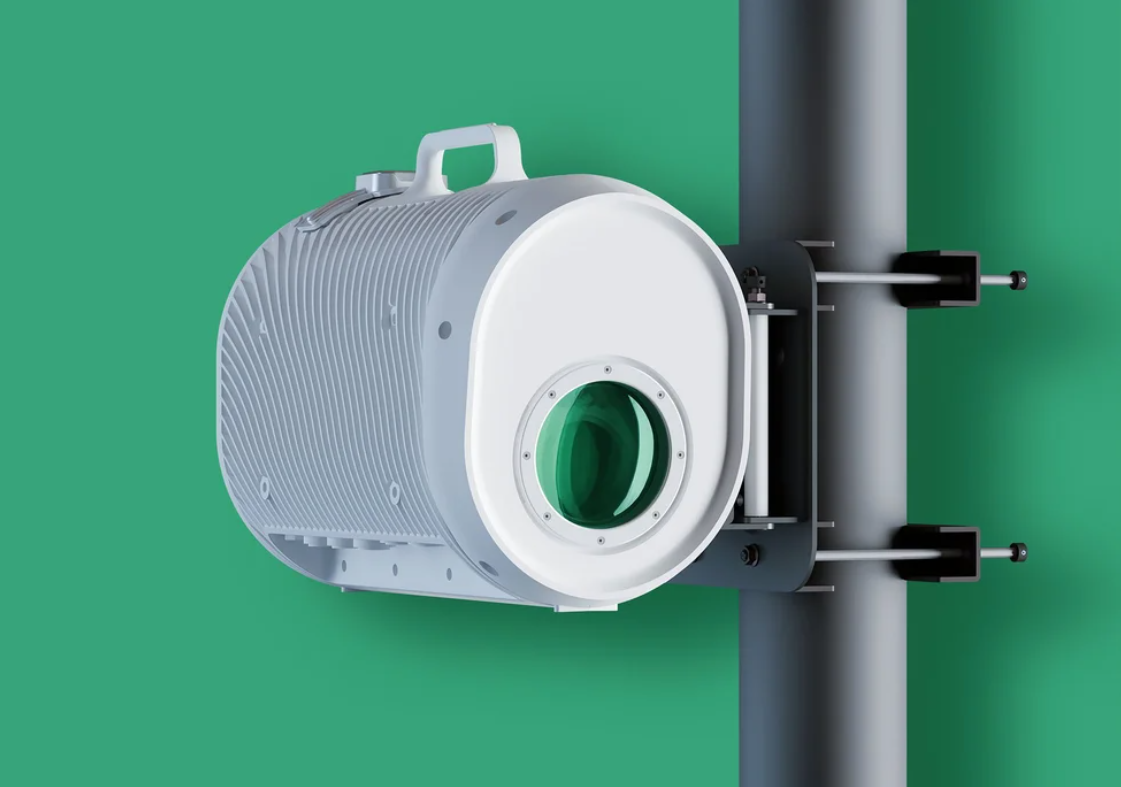
At the recent Mobile World Congress in Barcelona, Taara unveiled its latest breakthrough: Taara Beam. This compact, shoebox-sized device weighs a mere 8 kilograms but packs a formidable punch. It is designed to deliver speeds of up to 25 gigabits per second with a latency of just 50 microseconds. This is not merely "fast" for wireless; it is competitive with the highest-tier physical fibre connections. The beauty of the system lies in its simplicity of deployment, as these units can be mounted easily on utility poles or the sides of buildings, effectively jumping over the "right-of-way" legal hurdles that often leave urban structures data-starved despite being mere metres away from a fibre landing point.
The Science of Shrunk Photonics
The engineering feat behind Taara Beam involves shrinking complex photonics into a weather-hardened, portable frame. CEO Mahesh Krishnaswamy describes the terminal as a combination of a digital camera and a laser pointer. However, the precision required is immense; the laser must maintain a lock across several kilometres of open air with a margin of error of only a few degrees. To achieve this, Taara uses a sophisticated phased array approach on a fingernail-sized silicon chip.
Unlike traditional systems that might use mechanical mirrors to steer a beam, Taara’s photonics chip splits a single laser into over a thousand individual streams. By minutely delaying the phase of each stream, much like timed pebbles dropped into a pond to create specific ripple patterns, the system can electronically steer the resulting wavefront in any direction. This allows the device to maintain a perfect link even if the mounting structure vibrates or shifts slightly, a common challenge for high-frequency optical communications.
Reliability in All Weathers
While the new Beam unit focuses on compact efficiency, Taara's existing Lightbridge Pro series addresses the primary historical weakness of Free Space Optics (FSO): the weather. Fog and heavy rain can scatter light, potentially dropping a connection. Taara solves this by integrating an automatic radio-frequency backup. When optical conditions degrade, the system seamlessly switches traffic to a radio link. Once the skies clear, it snaps back to the high-capacity laser connection. This hybrid approach allows Taara to claim "five-nines" reliability, 99.999% uptime, translating to less than five minutes of downtime over an entire year.
A Major Leap Forward for the LiFi Ecosystem
The advancements pioneered by Taara are not just a win for long-range wireless; they provide a critical backbone for the broader Light Fidelity (LiFi) industry. While LiFi typically focuses on short-range, indoor networking, using LED or infrared lights to provide secure, high-speed data to laptops and tablets, it requires a robust "data pipe" to feed those access points.
Taara’s technology can bridge the gap between the fibre backbone and the LiFi-enabled building. By providing a high-capacity, low-latency optical link from a remote fibre hub directly to a rooftop, Taara ensures that the "wireless" journey of data remains entirely light-based from the source to the end-user device. This avoids the bottlenecks and electromagnetic interference associated with traditional radio-frequency backhaul. Furthermore, the miniaturisation of phased-array photonics developed for Taara Beam could eventually trickle down into consumer LiFi hardware, leading to smaller, more efficient transceivers that can steer beams to mobile users within a room with pinpoint accuracy.
As Taara looks toward the future, the company sees potential far beyond terrestrial poles. The compact, high-speed modules are being eyed for "data centre-to-data centre" communication in space. In an environment where running physical cables is impossible, these optical links will allow satellite constellations to share terabits of data instantaneously. Whether in the vacuum of orbit or the crowded streets of a modern city, Taara is proving that the future of connectivity is not buried in the ground, but shining through the air.