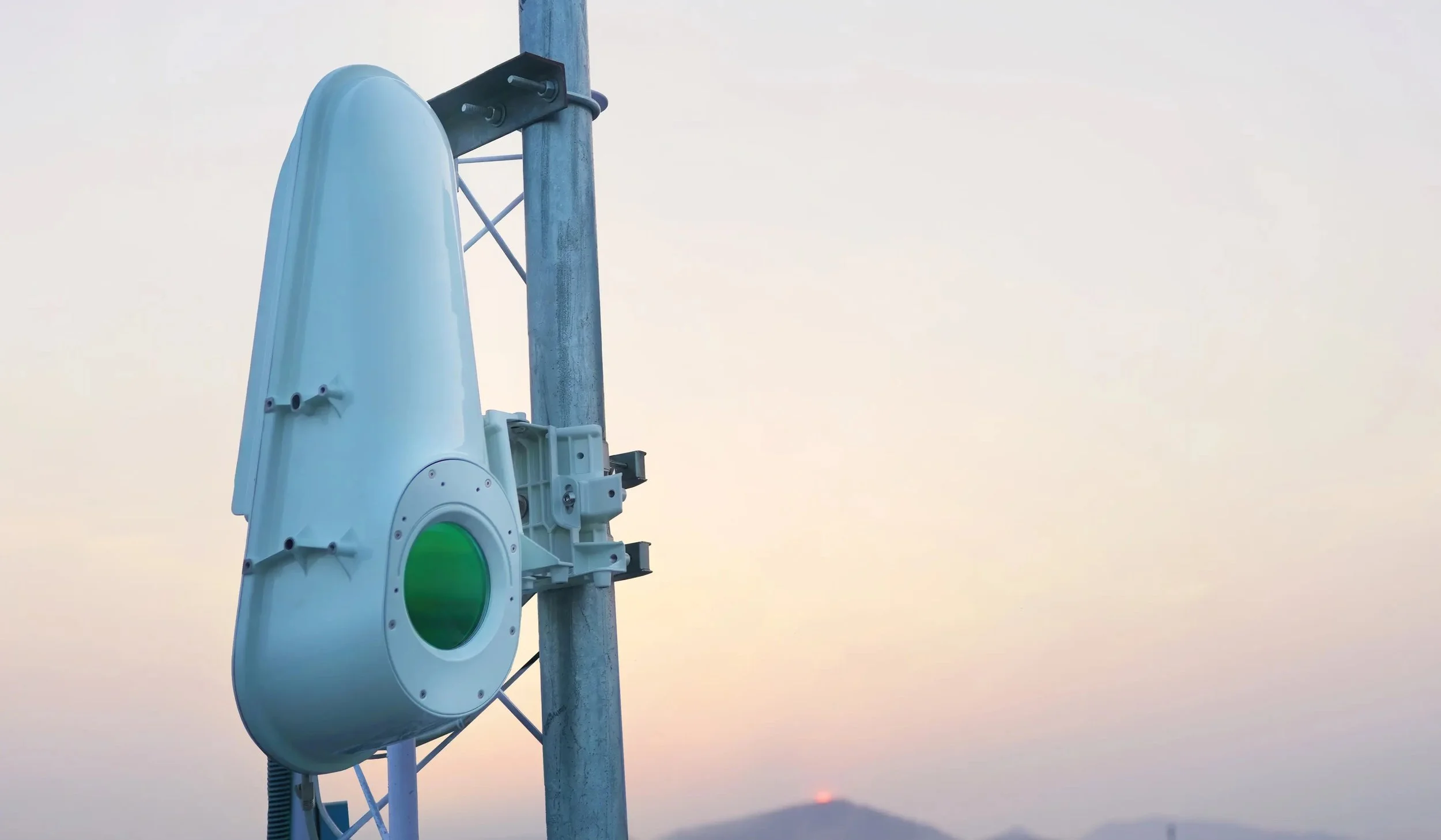
Image credit to Taara
We live in an era defined by insatiable digital demand. From the exponential boom in artificial intelligence and machine learning to the endless streams of high-definition video and cloud computing, the modern world runs on data. At the physical heart of this digital revolution are data centres, massive, power-hungry facilities that process and store the lifeblood of our economy. But data centres share a fundamental vulnerability: they need fibre-optic cabling, and they need lots of it.
Lately, as I’ve watched supply chain bottlenecks and logistical nightmares cripple infrastructure rollouts across the tech industry, I’ve been thinking: is optical wireless communications the answer to fibre shortages for data centres and other places they use fibre heavily?
After looking into the recent moves by Taara, a pioneering wireless optical technology company, the answer looks increasingly like a resounding "yes", at least as a crucial bridge and backup. Here is a deep dive into why wireless optical links might just be the fast, high-bandwidth fix the data centre industry has been desperately waiting for.
The Great Fibre Bottleneck
To understand the appeal of optical wireless communications, we first have to understand the severity of the current fibre bottleneck. Data centres are entirely dependent on high-speed, high-bandwidth connections to the outside world. Traditionally, physical fibre-optic cables have been the only medium capable of handling these immense data loads reliably.
However, laying fibre is not a simple task. It requires extensive physical labour, complex permitting processes, and significant time. Today, the industry is being battered by a perfect storm of workforce shortages and persistent supply chain issues. The lead times required to procure and lay physical fibre have stretched out agonisingly, leaving newly built or expanded data centres entirely disconnected from the broader network grid.
This delay creates a massive financial problem for data centre operators, opening the door for innovative players who can provide high-bandwidth links at a fraction of the time and physical effort.
The Cost of Waiting: Compute as a Depreciating Asset
When a data centre is built but cannot be connected to the internet due to fibre delays, it isn't just an empty building—it is a warehouse full of rapidly aging technology.
Mahesh Krishnaswamy, the CEO of Taara, recently highlighted this exact dilemma in an interview with Fierce. “One of the biggest challenges they’re facing is that they are sitting on a large amount of chips and compute which is not being put into production while they are waiting for the rest of the infrastructure to be built out,” he noted.
In the fast-paced world of technology, compute power is a rapidly depreciating asset. The latest generation of processors and AI accelerators lose their competitive edge and financial value month by month as newer models are developed. If these expensive chips sit idle in a dark data centre waiting for a trench to be dug and fibre to be laid, the financial losses are catastrophic.
As Krishnaswamy bluntly explained, “By the time the buildings are up and running… you’ve already lost a significant amount of opportunity cost and value from those chips.” Data centre operators need a way to get their compute online now, not in six to twelve months.
Enter Taara: The "Bridge and Backup" Strategy
This is precisely where optical wireless communications steps in. Taara has developed technology capable of beaming high-speed data through the air using light, effectively creating an invisible, wireless fibre-optic cable.
Currently, Taara provides stackable 20 Gigabits per second (Gbps) wireless optical links that can stretch up to 20 kilometers (about 12 miles). Because these links require no trenching, no underground permitting, and no extensive physical labour to lay miles of cable, they can be deployed in a fraction of the time it takes to install traditional fibre.
Krishnaswamy envisions Taara’s technology functioning in a two-part lifecycle for data centres. First, it serves as a vital bridge technology. By deploying wireless optical links, data centre operators can bypass fibre lead times and get their facilities online and generating revenue immediately. The chips are put to work, and the opportunity cost is mitigated.
Second, once the physical fibre is eventually laid and connected, the Taara links don't just become obsolete; they transition into a highly reliable backup technology. Physical fibre is notoriously vulnerable to cuts, whether from careless construction backhoes, natural disasters, or vandalism. Having a wireless optical link running parallel to the physical fibre ensures that if the fixed line is severed, the data centre remains online, securing the holy grail of the industry: uninterrupted uptime.
From the Stratosphere to the Data Centre: Taara’s Roots
If the concept of beaming high-speed internet through the air sounds like science fiction, it’s worth looking at Taara’s pedigree. Interestingly, Taara traces its roots directly back to Google’s famous Project Loon.
Throughout the 2010s, Project Loon attempted to provide broadband internet to remote areas using high-altitude weather balloons. While Loon was ultimately wound down in 2021, the incredibly advanced wireless optical communications technology it used to beam data between balloons in the stratosphere was far too valuable to abandon.
This technology was repurposed for terrestrial use under a new initiative: Project Taara. Established in 2017 within Google's parent company, Alphabet, Project Taara spent years refining its ground-based optical links. In early 2025, the project successfully spun out of Google to become the independent company it is today.
Targeting the Right Market: Tier 2 and Tier 3
Despite its historical ties to Google, one of the three largest hyperscalers on the planet, Taara is taking a calculated, grounded approach to its market entry. The company is not immediately targeting the hyperscale data centres for its primary rollout.
The reason comes down to pure bandwidth mathematics. Hyperscalers operate at a scale that is difficult to comprehend, requiring mind-boggling connectivity speeds of 800 gigabits, 1.6 terabits, and beyond. While Taara’s technology is incredibly fast, a single 20 Gbps link is a drop in the bucket for a hyperscaler.
Instead, Taara is focusing its sights on smaller Tier 2 and Tier 3 data centres. These facilities typically require bandwidth in the 100 Gbps range. Because Taara’s boxes are stackable, operators can pair several 20-gig wireless optical links together to comfortably achieve these speeds. In fact, Krishnaswamy noted that Taara has already successfully achieved a 160 Gbps link in testing simply by pairing its boxes next to each other.
Taara isn't resting on its laurels. The company has a clear roadmap to eventually increase its capacity from tens of gigabits to hundreds of gigabits, and eventually terabits per second, positioning itself to serve even the largest hyperscalers in the future.
Overcoming Industry Hesitation
Of course, having a technology that works in a vacuum is very different from successfully breaking into the enterprise data centre market. In the data centre realm, uptime is everything, and operators are famously risk-averse.
“When you bring in a novel technology, there is a little bit of curiosity, but also hesitation to take a bet on this,” Krishnaswamy admitted. “But at the same time they are hurting.” The pain of supply chain delays and depreciating hardware is forcing the industry to look past its traditional conservatism.
Taara's strategy is to gently walk these operators from intrigue to implementation. “More often than not, they start with awareness to interest and then we go into some initial pilots,” Krishnaswamy explained. Currently, Taara is navigating this “awareness to consideration” phase with several players, hoping to quickly advance them into active pilot programs to prove the technology's reliability in real-world scenarios.
The Road Ahead: Beyond the Data Centre
While data centres are the immediate focus for the next 12 to 18 months, optical wireless communications has massive potential across multiple sectors that rely heavily on fibre.
Taara is simultaneously pushing ahead to target enterprise, metro, and interconnect markets. Furthermore, the company is actively developing a new version of its technology specifically optimised for shorter-hop applications of around 10 kilometers. This shorter-range tech would be absolutely ideal for last-mile use cases or connecting edge data centres, which are becoming increasingly vital for reducing latency in AI processing and autonomous vehicle networks.
Could we see this technology on our homes one day? Perhaps. But as Krishnaswamy pragmatically pointed out, pushing 20-gigs to a residential home is largely considered “overkill” for now.
Conclusion
So, is optical wireless communications the answer to fibre shortages?
It may not entirely replace the need for physical fibre in the long term, but it is undeniably emerging as the most viable, high-speed solution to the immediate crisis. By acting as a rapidly deployable bridge technology, it solves the acute financial pain of depreciating, idle compute. By acting as a fail-safe backup, it provides the ultimate resilience against physical infrastructure damage.
For data centres and other fibre-heavy industries suffocating under the weight of supply chain delays and workforce shortages, companies like Taara are offering a breath of fresh air, and beaming data right through