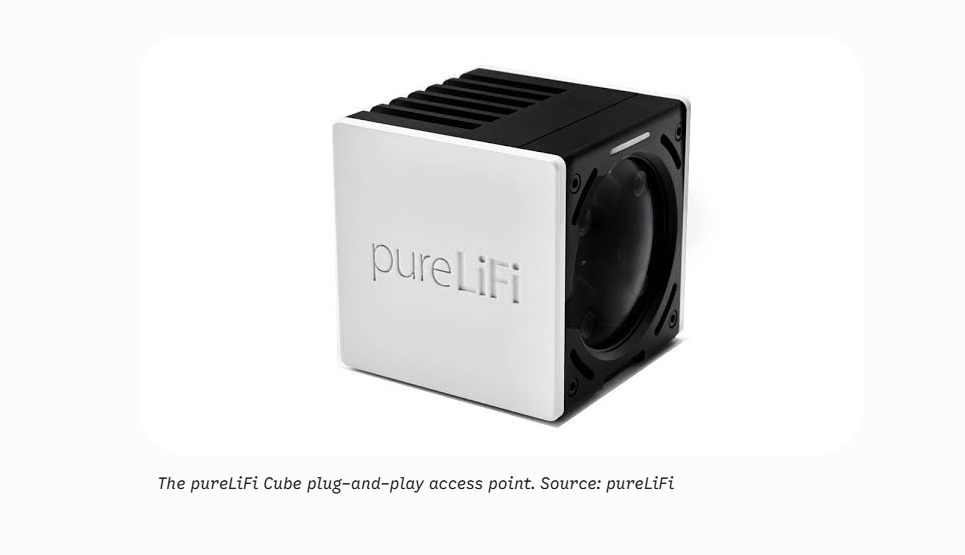
What is the potential for LiFi to solve the global radio frequency (RF) spectrum crunch?
For decades, we’ve relied on radio frequencies (RF) to connect our world. From the first cell phones to the billions of smart devices currently online, the invisible waves of Wi-Fi, 4G, and 5G have been the backbone of the digital age. But we are rapidly approaching a wall known as the "spectrum crunch."
The spectrum crunch is the looming shortage of wireless radio frequencies caused by the surging demand for mobile data and connected devices. As more people use smartphones, tablets, and smart tech, the invisible airwaves used to transmit data risk becoming too crowded
Put it simply, the RF spectrum is finite, and we are running out of room. The spectrum crunch refers to the lack of sufficient wireless frequencies needed to support the explosive growth of connected consumer devices, which was forecasted to surpass 20 billion Internet of Things (IoT) devices.
To accomodate the growing demand of connectivity, LiFi is needed.
The Problem: A Crowded Radio Highway
Think of the RF spectrum as a multi-lane highway. Over the last 20 years, we’ve added millions of new "vehicles" such as smartphones, laptops, smart TVs, and IoT sensors, onto this same highway.
To keep traffic moving, we’ve subdivided the lanes (using new standards like Wi-Fi 6) and built new, narrower lanes at higher frequencies (like mmWave 5G). But physics dictates that there are only so many radio frequencies available for commercial use. As network traffic continues to increase, the spectrum approaches total congestion.
The Solution: 1,000x More Capacity
While the entire radio, microwave, and millimetre-wave spectrum tops out at around 300 GHz, the visible light spectrum is estimated to be 1,000 to 10,000 times larger than the entire RF spectrum.
By shifting data transmission from crowded radio waves to the vast, untapped visible light spectrum, LiFi offers a massive expansion of our communication infrastructure.
Here is how LiFi uniquely solves the crunch:
Massive Bandwidth: LiFi can unlock unprecedented data rates and bandwidth by using a spectrum more than 1,000 times greater than the entire spectrum used for radio frequencies.
Unlicensed and Free: Unlike the RF spectrum, which governments heavily regulate and auction off to telecom giants for billions of dollars, the visible light spectrum is plentiful, free, and completely unlicensed.
Dense Network Offloading: LiFi is highly directional. Because light doesn't pass through walls, every room with a LiFi-enabled light becomes its own isolated, high-speed network. This allows for immense "spatial reuse." Dozens of LiFi networks can operate in a single office building without ever interfering with one another, effectively offloading massive amounts of data traffic from the central Wi-Fi router.
A Hybrid Future
LiFi isn't designed to kill Wi-Fi; it’s designed to relieve it of growing faster and secure connectivity demand.
Because LiFi relies on light, it can't transmit data through walls or inside a pocket. Therefore, the future of connectivity isn't a zero-sum game between light and radio. The solution to the spectrum crunch is a hybrid architecture where LiFi handles the heavy lifting of high-bandwidth, stationary, or indoor tasks, freeing up the limited RF spectrum for devices on the move.