Oledcomm CEO Interviewed By LiFi Tech News On The LUCI Project

Mr Benjamin Azoulay, CEO of Oledcomm, one of the leading LiFi companies in the LiFi industry, was recently interviewed by LiFi Tech News about satellite communications through the LUCI project. This article will provide a summary of the interview. Another article will be made with the full transcript. A big thank you to Mr Avtansh, from Licence K, for helping us to set up the interview. The interview started by LiFi Tech congratulating the entire Oledcomm of their recent achievements. Benjamin Azoulay also explained, the transition from terrestrial optical wireless communication to space-based laser systems represents a natural evolution of the company's core expertise.
"At the end of the day, laser is light," Azoulay notes. "We are a company specialised in optical wireless communication. It can be LED, we sometimes use VCSELs (vertical cavity surface emitted lasers), and now it's real lasers. So it was a natural move for our R&D team."
The LUCI project emerged from both technical capability and business necessity. While Oledcomm remains committed to LiFi technology, Azoulay recognised the need for a complementary growth engine. "The market of LiFi is emerging slower than I expected," he admits. "As a business owner, as a CEO, you have to be pragmatic and find a strategy that makes your company sustainable in the short term."
The opportunity materialised through Oledcomm's existing relationship with CNES, the French space agency. Having collaborated on five or six LiFi projects in space, the company was well-positioned when CNES launched a competitive tender for laser communication between satellites.
Extreme Performance in Extreme Conditions
The technical specifications of LUCI are nothing short of remarkable. The system is designed to achieve 100 gigabits per second transmission speeds across distances of up to 8,000 kilometers between satellites. This performance must be maintained while satellites move relative to each other at speeds of 15 kilometers per second,a testament to the sophisticated pointing, acquisition, and tracking systems incorporated into the design.
Perhaps more challenging than the speed requirements are the environmental conditions. Space presents an extreme operational environment characterised by intense radiation, dramatic temperature variations, vacuum conditions, and the shock and vibration experienced during launch. LUCI must perform flawlessly despite these harsh conditions.
The Ultra-Lightweight Advantage
One of LUCI's most significant differentiators lies in its weight optimisation. Thanks to proprietary patents in photonics, Oledcomm has developed what they call "ultra-compact, ultra-lightweight" technology. The company targets a 50% weight reduction compared to competing solutions,a crucial advantage in an industry where every kilogram carries a premium.
"On each satellite, you have three or four of those products sometimes," Azoulay explains. "Can you imagine if you can save up to 30 or 40 kilos per satellite? It's a big differentiation."
This weight advantage becomes even more significant when considering large constellation deployments, where the cumulative savings can translate to substantial cost reductions and improved satellite performance.
Security and Resilience in the Digital Age
Beyond raw performance, LUCI addresses critical security concerns that traditional RF communications cannot match. Laser communications offer inherent advantages in terms of security and resilience,they are extremely difficult to intercept and virtually impossible to jam.
"It's very resilient communication," Azoulay emphasises. "It's not possible to intercept. So it's very resilient communication system."
These security features are becoming increasingly important as satellite communications handle more sensitive data and as the risk of interference or cyberattacks on space infrastructure grows.
Market Positioning and Pricing Strategy
Currently, laser communication systems command a premium over traditional RF equipment,approximately four times the cost according to Azoulay. However, he believes this pricing gap will narrow as volumes increase and the technology matures.
The European IRIS² constellation represents a significant early adopter, planning to deploy three LUCI terminals per satellite. Azoulay predicts that increasing adoption will drive down costs while the superior performance characteristics justify the premium.
"My vision personally is that in a few years, every satellite will get a laser comm solution," he states. "Even if they don't need it immediately, they will equip it just in case there is a need to communicate."
Diverse Applications and Use Cases
LUCI's applications extend across two primary use cases, each addressing different aspects of modern satellite communication needs:
Satellite-to-Satellite Communication: The primary application involves creating mesh networks within satellite constellations. This allows satellites to communicate directly with each other without relying on ground infrastructure, enabling more efficient routing and reduced latency for global communications.
Ground-to-Satellite Communication: LUCI can also facilitate high-speed connections between satellites and optical ground stations, supporting applications like space-based data centers that require extremely high bandwidth connections to Earth.
Looking further ahead, the technology could enable long-distance laser communication between terrestrial assets, ships, vehicles, and buildings, expanding its utility beyond the space domain.
Development Timeline and Milestones
Oledcomm is following a rigorous, milestone-based development process guided by CNES. The systematic approach includes system requirement reviews, product design reviews, critical design reviews, and readiness reviews,a proven framework developed specifically for introducing new innovations in space.
The timeline targets orbital demonstration by late 2027 or 2028, a crucial milestone that will validate the technology's real-world performance. Currently, only four companies worldwide have successfully demonstrated laser communication in orbit, highlighting the significant technical challenge involved.
Global Ambitions and Partnerships
Despite its French origins, Oledcomm maintains worldwide ambitions for LUCI. The company actively seeks partnerships with organisations in the UK, United States, and other regions. Recent participation in the Dubai Air Show demonstrates this global outreach, with discussions already underway with international satellite manufacturers.
Future Technology Roadmap
The rapid advancement of data centre technologies is driving innovation in laser communication speeds. Oledcomm benefits from this ecosystem, leveraging commercial developments in high-speed optical communication for space applications.
"We are already seeing emerging commercial solutions for one terabyte per second," Azoulay notes. "We'll certainly be able to use that also. The segment of free space optics is really driven by the data center application and submarine cables."
This technology transfer from terrestrial applications to space systems suggests that LUCI's performance will continue to improve, potentially reaching terabyte-per-second speeds within the next five years.
Industry Impact and Implications
LUCI represents more than just a new product,it signals a fundamental shift in how satellite communications will evolve. As constellations grow larger and more interconnected, the need for high-speed, secure, lightweight communication systems becomes critical.
The project also demonstrates how specialised expertise in one domain (LiFi) can successfully transfer to adjacent markets (satellite communications). This cross-pollination of technologies may inspire similar innovations across the industry.
Conclusion
Oledcomm's LUCI project stands at the intersection of multiple technology trends: the proliferation of satellite constellations, the demand for higher bandwidth communications, and the increasing importance of secure, jam-resistant connections. By leveraging their optical wireless communication expertise and developing breakthrough photonics patents, Oledcomm has positioned itself to capture a significant share of the growing satellite laser communication market.
As the space economy continues its rapid expansion, solutions like LUCI will prove essential for enabling the next generation of satellite-based services. With its combination of extreme performance, weight optimisation, and security features, LUCI represents a compelling vision for the future of space communications,one where light itself becomes the medium for connecting our increasingly satellite-dependent world.
The success of LUCI could well establish Oledcomm as a major player in the space communication industry while providing the sustainable growth engine the company needs to complement its LiFi innovations. As we approach the 2027-2028 orbital demonstration, the industry will be watching closely to see if this ambitious vision becomes reality.
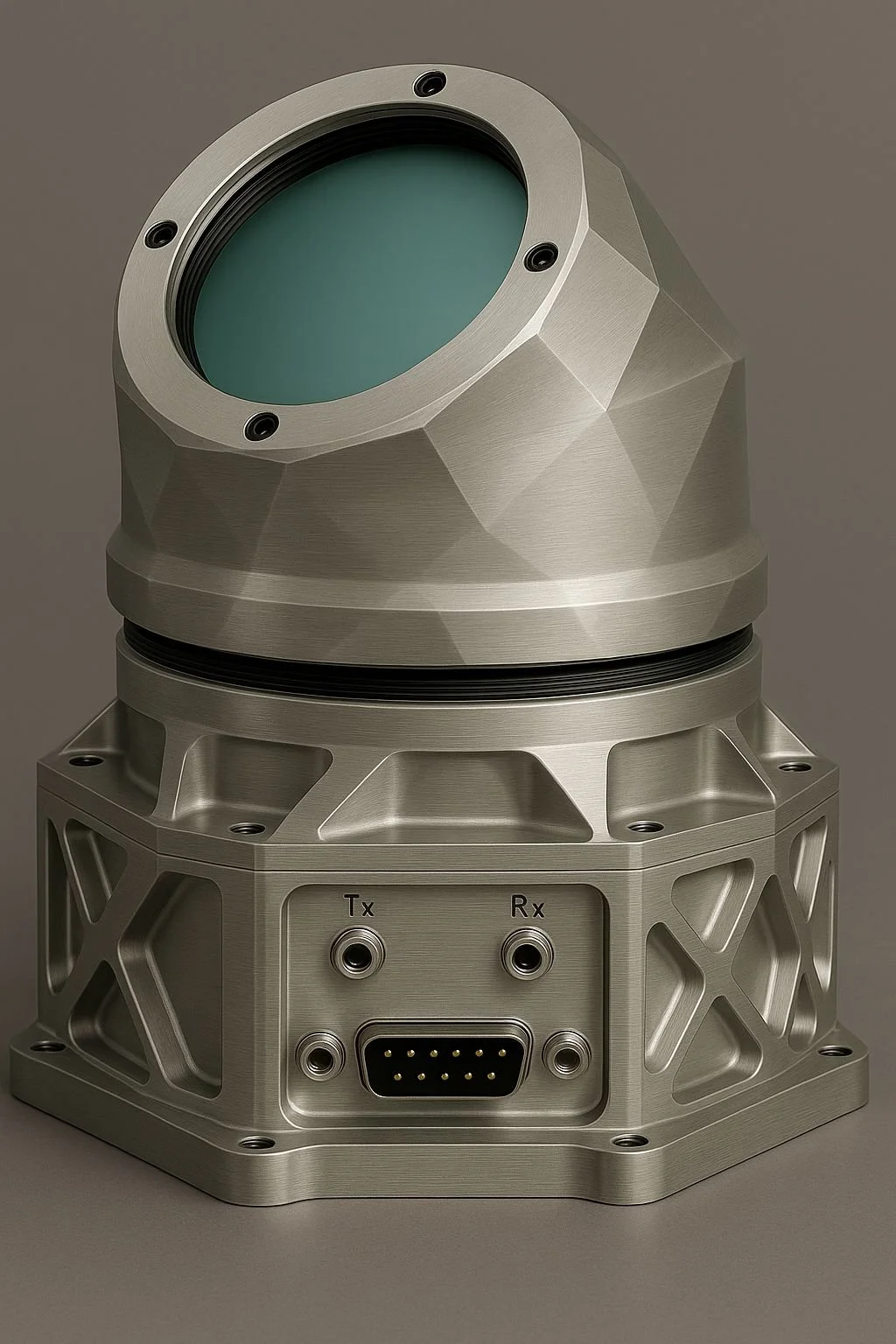
Image Credit and special thanks to Oledcomm - Oledcomm's Optical Head Unit concept is an optical head installed externally on the satellite to enable it to communicate via laser at 100 Gbps.