Oledcomm Discussed With Optica About Their LiFi Business
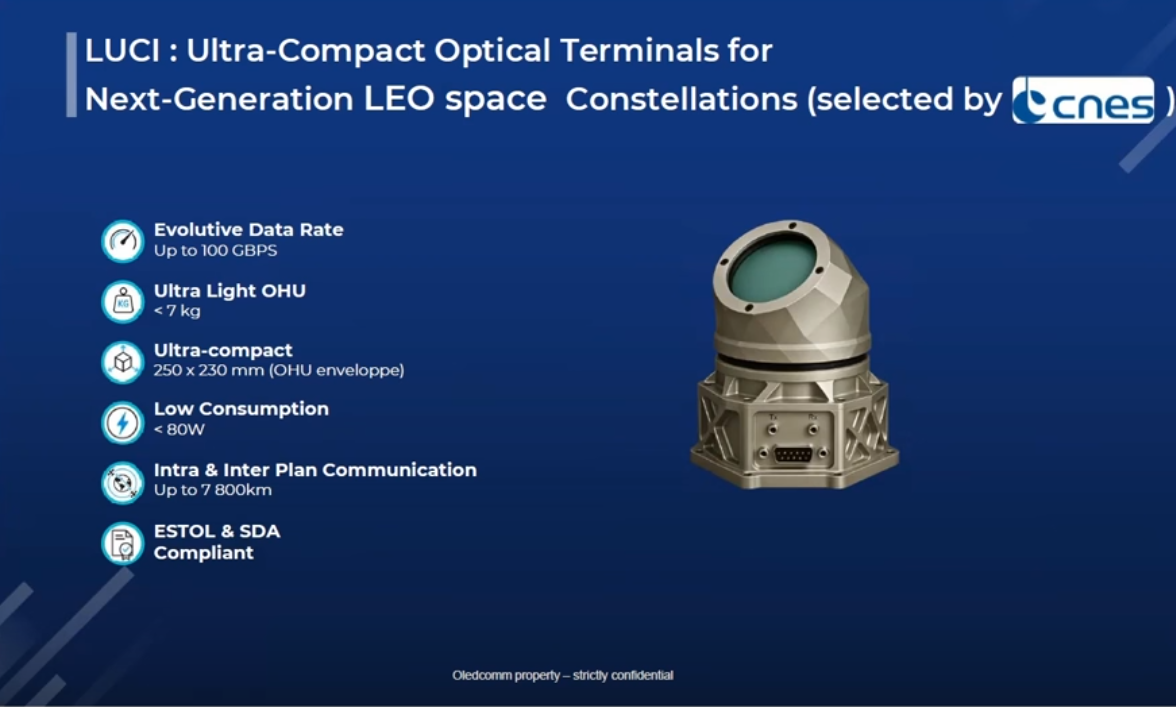
Image credit to Oledcomm
By LiFi Tech News Team
Benjamin Azoulay, CEO of the French LiFi pioneer Oledcomm, pulled back the curtain on the company's aggressive expansion strategy. With over a decade of expertise, a team of 40 specialists based near Versailles, and a robust portfolio of over 36 patents, Oledcomm is no longer just testing the waters, they are embedding Optical Wireless Communication (OWC) into the very fabric of critical global infrastructure.
From the tunnels of the Paris Metro to the vacuum of Low Earth Orbit, Azoulay laid out a roadmap that transitions LiFi from a niche technology to a "sovereign" necessity. However, the presentation also came with a challenge to the hardware industry: to unlock the next level of speed, Oledcomm needs a new generation of light emitters.
The Foundation: The "One Euro Cent" Revolution
Before diving into massive infrastructure projects, Azoulay highlighted the tiny technological marvel powering their ecosystem. Oledcomm has successfully miniaturised their optical front-end module to the size of a one-euro cent coin.
This micro-module is a feat of engineering, integrating a Vertical-Cavity Surface-Emitting Laser (VCSEL), two photodiodes, and a custom-designed analog front-end chip. Despite its diminutive size, this block is the powerhouse behind their products, capable of sending and receiving data at 1 Gbps over a 25-degree beam at a distance of 10 meters. It serves as the fundamental building block for every application Oledcomm deploys, proving that massive industrial capability can start with microscopic innovation.
Frontier 1: Space – The "High LEO" Success and LUCI
Oledcomm has officially taken LiFi out of this world. Azoulay confirmed a major milestone: since May 2023, their technology has been operating successfully aboard a OneWeb satellite at an altitude of 1,200 kilometres.
Dubbed "High LEO" (Low Earth Orbit), this application uses OWC to replace heavy, cumbersome copper cabling inside the satellite ("intra-satellite" communication). The success of this deployment, where the product continues to function flawlessly in the harsh environment of space, has paved the way for an even more ambitious project.
In partnership with the French Space Agency (CNES), Oledcomm is developing LUCI (Liaison Ultra Compact Inter Satellite). This is not just for inside the satellite, but for talking between them.
Range: LUCI is designed to establish optical links up to 7,800 kilometres.
Complexity: It handles both intra-plane communication (satellites moving together) and inter-plane communication (satellites with drastically different relative velocities).
Weight: The optical head unit weighs less than 7 kilograms, making it one of the most compact solutions in the aerospace market.
Frontier 2: Transportation – The Paris Metro
Oledcomm is preparing to equip the upcoming Line 18 of the Paris Metro, a vital link connecting Orly Airport to Versailles. The deployment addresses a modern data crisis: the "Terabyte Flood."
Modern autonomous trains are rolling data centres, equipped with up to 30 High-Definition CCTV cameras covering every angle (front, rear, sides, and interior). Between two stations, these cameras generate terabytes of data that must be offloaded for security and maintenance.
The LiFi Solution: Oledcomm has installed LiFi transceivers at station stops. During the brief 20-second window when the doors open, the train establishes a link capable of 2.6 Gbps upload and download speeds. This allows for the rapid "dump" of massive video files without clogging the public Wi-Fi or LTE networks.
The Wireless Jumper: Beyond data offloading, the technology is used to bridge connections across railway tracks. Traditional methods require digging expensive trenches under tracks to lay cables. Oledcomm’s wireless link provides a secure, interference-free "jump" over the rails, immune to the heavy electromagnetic noise generated by high-voltage train lines.
Frontier 3: Defence – The "Sovereign" Command Tent
In the defence sector, speed and security are paramount. Oledcomm showcased a rapid-deployment solution designed for mobile command centres.
Instant Infrastructure: A single LiFi access point, mounted on the ceiling of a tent or shelter, can connect up to 32 users simultaneously.
Speed: A fully secure network can be set up in under 10 minutes, eliminating the need to lay miles of ethernet cables.
Security: Unlike radio frequency (RF) signals which can be jammed or intercepted from miles away, LiFi stays strictly within the physical walls of the tent.
Certification: The system has achieved "Secret" level security certification in France and Germany (BSI), with NSA certification in the United States currently in the final stages.
Crucially, Azoulay touched on the concept of "Sovereignty." Defence clients are increasingly demanding that their technology be manufactured within their own geopolitical borders. European armies want European chips; US forces want US chips. Oledcomm is actively adapting its supply chain to meet these "geographically constrained" requirements.
The Industry Call to Action: The Hunt for Faster Emitters
Perhaps the most significant moment of the forum was Oledcomm’s direct appeal to the component industry. Azoulay was clear: current LED technology is hitting a wall.
Standard LEDs typically have a cutoff frequency of around 30 MHz, which severely throttles maximum data speeds. However, the market demand has shifted. Clients are no longer satisfied with Gigabit speeds; they are demanding a minimum of 10 Gbps before they consider switching from Wi-Fi or fibre.
To bridge this gap, Oledcomm is actively seeking partners and suppliers for next-generation emitters, specifically:
High-Power VCSELs: Vertical-Cavity Surface-Emitting Lasers that offer higher modulation speeds.
MicroLEDs: Which offer significantly better bandwidth than traditional phosphor LEDs.
Infrared Emitters: Specifically in the 850nm, 940nm, 1050nm, and the telecom-standard 1550nm wavelengths.
The LiFi Connection: Why This Matters
Oledcomm’s roadmap serves as a barometer for the entire LiFi industry. Here is how these developments correlate with the future of Optical Wireless Communication:
1. The End of "LiFi 1.0" The open call for VCSELs and lasers confirms that the industry is graduating from "LiFi 1.0" (using overhead LED lights for data) to "LiFi 2.0" (using dedicated infrared laser links). The future of high-speed LiFi is not in the light bulbs you buy at the hardware store, but in specialised, high-performance infrared systems that run parallel to visible lighting.
2. LiFi as Heavy Infrastructure The Line 18 Metro project proves that LiFi is ready for heavy industrial lifting. It is no longer just a novelty for office conference rooms; it is being trusted to handle safety-critical data for mass transit systems. This shift from "consumer gadget" to "critical infrastructure" significantly raises the valuation and seriousness of the technology.
3. The "Invisible" Spectrum Standard By focusing on wavelengths like 1550nm, Oledcomm is aligning LiFi with existing fibre-optic telecommunications standards. This "Invisible LiFi" approach allows for higher power (better range and speed) without posing eye-safety risks or creating distracting flickering lights, making it the ideal standard for industrial and defence applications.
4. Geopolitics in Tech The emphasis on sovereign supply chains highlights that LiFi is becoming a strategic asset. As governments look to secure their communications against foreign interception, LiFi’s inherent physical security combined with localised manufacturing makes it a key player in national defence strategies.
Oledcomm has laid down the gauntlet: the applications are ready, the clients are waiting, and the software is secure. Now, they just need the lights to blink faster.