Interview of Dr Saswati Paramita By LiFi Tech News on Her LiFi Research and Recent Achievements

Dr Saswati Paramita - Image credit to Dr Saswati
Recently, LiFi Tech News had the distinct pleasure of sitting down with Dr Saswati Paramita, a prominent researcher in the field of Light Fidelity (LiFi), to discuss her groundbreaking work, her collaborations with industry pioneers, and her vision for the future of wireless communication. She is a researcher in wireless communication and optical wireless networking. Her research focuses on Hybrid LiFi/WiFi Networks (HLWN), Wireless Optical Communication, Visible Light Communication (LiFi), mobility management, channel modeling, and intelligent resource optimization for Beyond-5G and 6G networks.
She earned her Ph.D. in Electronics and Communication Engineering from IIIT Delhi and her M.Tech. in Communication Engineering from IIT Kharagpur. With more than 10 years of teaching and research experience, she has contributed to cutting-edge research through publications in leading IEEE journals and conferences, a granted Indian patent, LiFi standardization activities through TSDSI, and international research collaborations.
The 2020 Catalyst: A Search for Alternate Connectivity
LiFi Tech News congratulated Dr Paramita on the recent completion and defence of her PhD thesis titled:
"Design, Modeling, and Optimization of Hybrid LiFi-WiFi Networks for High-Performance Indoor Wireless Communication."
The research resulted in
2 Indian Patent Applications, including one granted patent (2026)
5 published journal papers in leading venues including IEEE Transactions on Vehicular Technology, IEEE Communications Letters, IEEE Networking Letters, IEEE Open Journal of the Communications Society, and Computer Communications (Elsevier)
3 journal papers under review in IEEE Transactions on Mobile Computing and IEEE Transactions on Wireless Communications
10 international conference publications and demonstrations presented at premier conferences such as IEEE WCNC, VTC, ANTS, COMSNETS, PIMRC, and FNWF
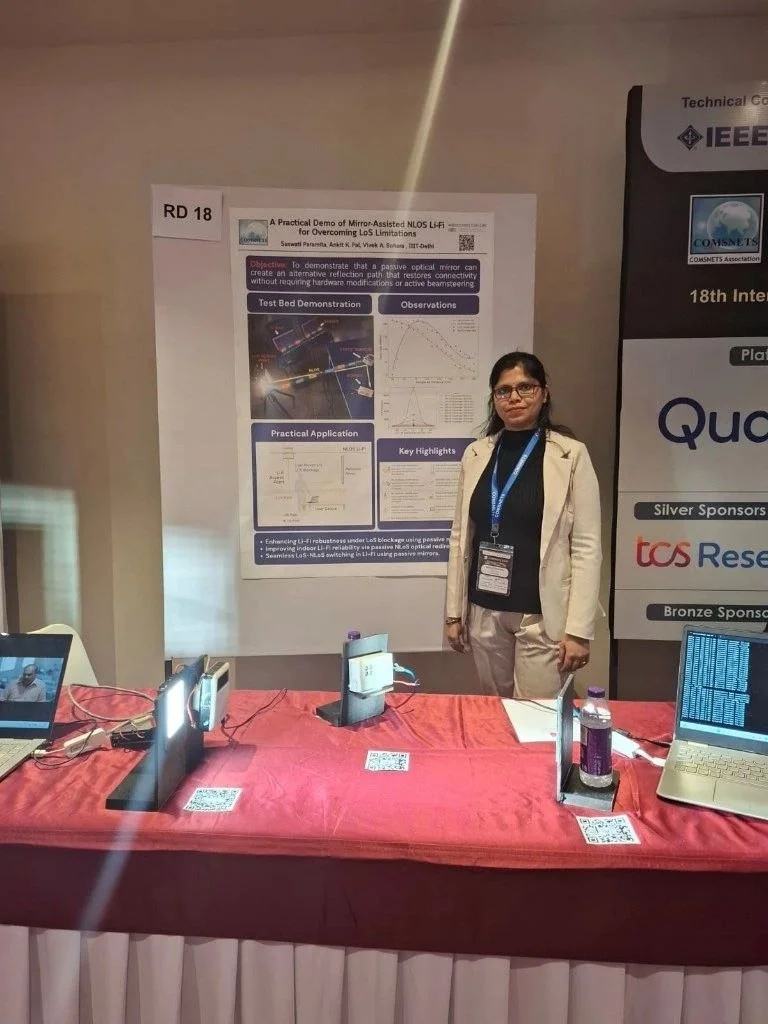
Photo credit to Dr Saswati Paramita
Dr. Paramita’s deep dive into LiFi technology was notably sparked in 2020. As the world navigated the unprecedented challenges of a global pandemic, the strain on existing telecommunications infrastructure became apparent.
During our interview, Dr. Paramita recalled how even the Government of India began actively exploring new, alternative connectivity solutions to cope with this unprecedented network burden. Recognising the limitations of relying solely on traditional Wi-Fi and cellular networks, Dr. Paramita saw immense potential in the untapped optical wireless communication spectrum. This pivotal period catalysed her dedication to advancing LiFi technology.
Bridging the Gap: The Power of LiFi/WiFi Hybrid Networks
A central focus of Dr. Paramita’s recent research has been the development and optimization of LiFi/WiFi hybrid networks. While WiFi is ubiquitous, it is often plagued by bandwidth limitations, latency issues, and signal dead zones in densely populated environments. LiFi, which uses visible and near-infrared light to transmit data, offers massive bandwidth and high-speed data transmission, but it often requires line-of-sight and cannot easily penetrate walls. LiFi’s limited coverage constrains its standalone effectiveness. To address this, Hybrid Li-Fi/Wi-Fi Networks (HLWN) integrate both technologies, combining the broad coverage of Wi-Fi with the high-speed potential of LiFi. Link Aggregation (LA) further enhances this hybrid approach by enabling simultaneous use of both links to improve overall throughput.
Dr. Paramita’s research heavily explores how these two technologies can be unified to create a seamless, robust network. In her hybrid architecture, the systems complement each other perfectly: where WiFi signals fall short or experience heavy congestion, the LiFi network seamlessly picks up the slack, strengthening overall connectivity and ensuring a consistently high-quality user experience. Results from this research showed that Link Aggregation-HLWNs consistently achieve lower outage probabilities across diverse scenarios, proving LA’s effectiveness in combining LiFi and Wi-Fi strengths to meet growing indoor communication demands. Dr Saswati stated that the data rate of these HLWNs were in the high end of Mbps.
Overcoming Environmental Hurdles: The Sunlight Question
One of the most common critiques and technical challenges associated with LiFi technology is its performance in bright, natural light. Critics often ask: Will a light-based communication system fail when exposed to direct sunlight?
When posed with this question, Dr. Paramita offered a reassuring and highly technical response. She explained that her hybrid networks, and modern LiFi receivers in general, are equipped with highly specialised optical filters. These advanced filters are designed to precisely isolate and separate natural sunlight from the specific modulated light signals emitted by the LiFi transmitters. Because the sunlight is filtered out before it can overwhelm the photodetectors, the system’s functionality and data transmission rates remain entirely unaffected, even in brightly lit environments.
Collaboration with other LiFi researchers
Dr. Paramita’s journey in optical wireless communication has allowed her to work alongside some of the brightest minds in the industry. Most notably, she has collaborated with top-tier researchers of IIIT Delhi. She stated that Prof. Haas recognizes their research group of CoE LiFi of IIIT-DELHI .
Furthermore, her research is deeply rooted in practical, real-world applications. Over the past few years, she has worked extensively with commercial LiFi hardware, specifically using systems developed by Velmenni. This hands-on experience with cutting-edge commercial hardware has allowed her to bridge the gap between theoretical research and tangible, consumer-ready technology.
Velmenni is a LiFi startup headed by current CEO Deepak Solanki since 2012. It was the first ever venture to explore the possibility of Visible Light Communications technology in India. It is focused on developing LiFi solutions that can transmit wireless data at extremely high speeds.
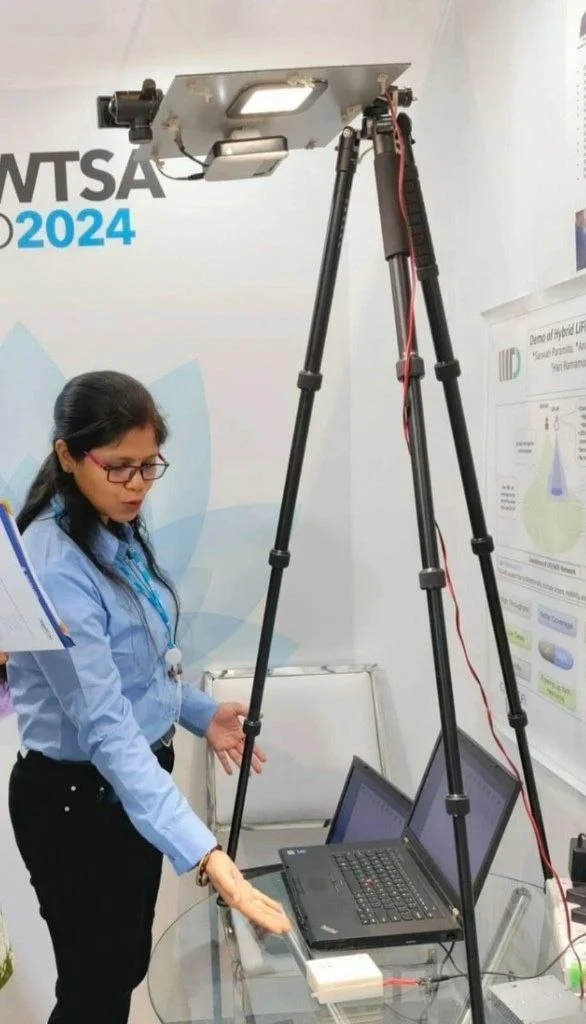
Photo credit to Dr Saswati Paramita
Looking Ahead: LiFi and the 6G Ecosystem
As the interview concluded, the conversation naturally shifted toward the future. When asked about where LiFi is headed, Dr. Paramita expressed a strong, unwavering belief in the widespread adoption of the technology.
While 5G is currently rolling out globally, the telecommunications world is already laying the groundwork for 6G. Dr. Paramita emphasised that LiFi will be a cornerstone of the upcoming 6G ecosystem. With 6G expected to demand ultra-low latency, unprecedented data rates, and massive network densification, traditional RF networks simply will not be able to shoulder the load alone. LiFi, with its vast, unregulated spectrum, secure and very fast data transmission capabilities, is perfectly positioned to serve as a key pillar in the next generation of global connectivity.
As for what it will take for LiFi to reach mass commercial adoption, Dr. Paramita highlighted the need for more hardware miniaturisation and standardization. The ultimate breakthrough, she noted, will occur when LiFi transceivers are integrated natively into everyday consumer devices, like smartphones, tablets, and laptops, right on the manufacturing line. There is also a need for all the relevant players in the LiFi space, manufacturers and players in the current connectivity space to come together and make this happen. Once the industry achieves this level of ubiquitous integration, LiFi will seamlessly transition from a niche technological marvel to an everyday utility.
For more information on Dr. Saswati Paramita's ongoing projects, publications, and background, you can visit her academic portfolio at https://sites.google.com/view/saswatiparamita/home.